
Structured for the Future: How Schema and Quality Score Fuels AEO and GEO
AI doesn't just find your website, it scores it!
It's not just about showing up anymore, it's about being understood and trusted. See how schema and content quality drive AI confidence.
When AI engines like Google's Search Gen Engine, ChatGPT, Perplexity, or Gemini decide what to include in an answer, they aren't only scanning for keywords. They're evaluating structure, trust, and clarity which signals to them your content is safe to use, factually sound, and contextually rich.
In the old world SEO, you optimized for rankings. In the new world of AEO (Answer Engine Optimization) and GEO (Generative Engine Optimization), you optimize for interpretation and confidence.
That confidence comes from two things:
- Schema markup, which teaches AI what your content means, and
- Quality Score, which tells AI your content can be trusted.
Together, these two core concepts still define how visible and how accurately represented your brand will be in AI-driven search.
From SEO to AEO + GEO: The Next Layer of Visibility
Search used to end with a blue link. Now it ends with an answer, and sometimes, if you're lucky, a link. Expect this space to keep evolving fast and for us to stay on the forefront.
AI doesn't just return search results — it pulls them together into a single, intelligent answer. It chooses which sources to reference, which facts to highlight, and which brands to name.
That process is guided by two layers of understanding:
- Semantic structure (via schema markup)
- Perceived quality (via content and performance signals)
Where SEO got you found, AEO and GEO get you featured.
Schema provides the data foundation; Quality Score provides the reputation. Together, they tell AI, "This content is relevant, accurate, and reliable enough to quote."
Schema: The Language AI Understands
Schema markup, the structured data embedded in your site, is how you describe your content in terms machines can reason with.
It's what helps AI recognize that a page isn't just text about "a motorhome," but about a…
- specific Product (2024 Grand Design Imagine 2670MK),
- with a Brand (Grand Design),
- listed by a LocalBusiness (Business Name, Tampa),
- complete with an Offer, Price, and Availability
Example: Schema in Action for an RV Dealer
Without schema, your page says:
"2024 Grand Design Imagine 2670MK available now at Lazydays Tampa."With schema, your page tells AI:
"This is a Product (2024 Grand Design Imagine 2670MK) manufactured by a Brand (Grand Design), listed by a LocalBusiness (Lazydays Tampa), currently InStock with an Offer that includes price, condition, and availability."
Example: Schema in Action for a Law Firm
Without schema, your page says:
"Meet Sarah Benatar, a personal injury attorney in Tampa who offers free consultations."With schema, your page tells AI:
"This is a LegalService offered by a LocalBusiness (Benatar Law Group), specializing in PersonalInjury, represented by a Person (Sarah Benatar, Esq.), with an Offer of free consultation."
Without schema, AI has to guess what a page represents. With schema, it knows.
That clarity makes your content more usable in AI answers, featured snippets, and even conversational recommendations. It's the digital equivalent of handing AI a perfectly labeled inventory feed instead of a stack of untagged photos – and that is what we do best!
Quality Score: The Trust Multiplier
Structured data gives AI context — but context without credibility doesn't earn placement.
That's where Quality Score comes in.
Traditionally, Quality Score referred to ad relevance and landing-page experience in paid media. In the AI era, it's evolving into a broader signal of content health and trustworthiness.
AI systems weigh factors like:
-
Accuracy – Is the information factually consistent with other trusted sources?
-
Consistency – Do schema, copy, and metadata align?
-
Engagement – Do users spend time on your content or bounce immediately?
-
Reputation – Are you cited, reviewed, and recognized as an authority?
-
Freshness – Is your data current, especially for time-sensitive inventory or pricing?
When schema and Quality Score work together, they reinforce each other:
- Schema makes your facts machine-readable.
- Quality Score makes those facts credible enough to surface.
This combination is what helps AI systems "decide" that your brand's version of the truth is worth repeating.
How Schema and Quality Score Fuel AEO + GEO
Both AEO and GEO rely on structured, trusted content.
Here's how they connect:
| Element | Purpose | What AI Looks For | How Schema + Quality Score Help |
|---|---|---|---|
| AEO (Answer Engine Optimization) | To prepare content for AI-driven answers (FAQs, voice, snippets) | Clear structure, factual precision, answer formatting | Schema tags (FAQPage, Product, Review) + high content trust |
| GEO (Generative Engine Optimization) | To prepare content for generative AI models (ChatGPT, SGE summaries) | Entity consistency, source credibility, structured facts | Connected schema + strong Quality Score = AI citation potential |
In short:
- Schema = Understanding
- Quality Score = Trust
- AEO + GEO = Visibility in AI answers
When your structured data aligns with clean, accurate, and consistently updated content, you give AI both the vocabulary and reason to include you.
The Future: AI-Driven Quality Scoring
Over time, expect the Quality Score to continue expanding beyond paid media and become a unified metric across SEO, AEO, and GEO.
Google and other engines are already measuring answer confidence — how reliably a piece of content supports AI-generated responses.
That confidence score will increasingly depend on:
- Structured data depth
- Fact alignment across sources
- Content freshness and format
- Brand consistency and accuracy
In other words: AI visibility will be earned through structure and trust, not just authority and links.
Why This Matters for Dealers, Businesses, and Professional Services
For dealerships, marketplaces, law firms, medical practices, and other service-based brands, structured data and Quality Score are the digital equivalent of a spotless showroom or a well-organized office. They're what ensure your business looks credible – not just clickable.
Schema ensures every product, service, or professional profile is clearly labeled, categorized, and discoverable.
Quality Score ensures every client or patient interaction builds trust — online, in search, and across AI-driven results.
As AI systems evolve, the brands and professionals with clean data, authoritative content, and consistent messaging will own the conversational layer of search whether someone's asking for a family RV, weekend trip, a personal injury lawyer, or a pediatrician nearby.
That's the new frontier — not just showing up, but being represented, quoted accurately, and recommended confidently.
TL;DR
- Your website isn't just a destination—it's a knowledgebase and a data source.
- AI engines are deciding which sources deserve to represent your industry.
- By pairing robust schema with a high Quality Score, you're not only future-proofing your visibility — you're teaching AI how to talk about you.
- Because in the AI era, visibility belongs to the brands that are both understood and trusted.
More from the blog
View all articles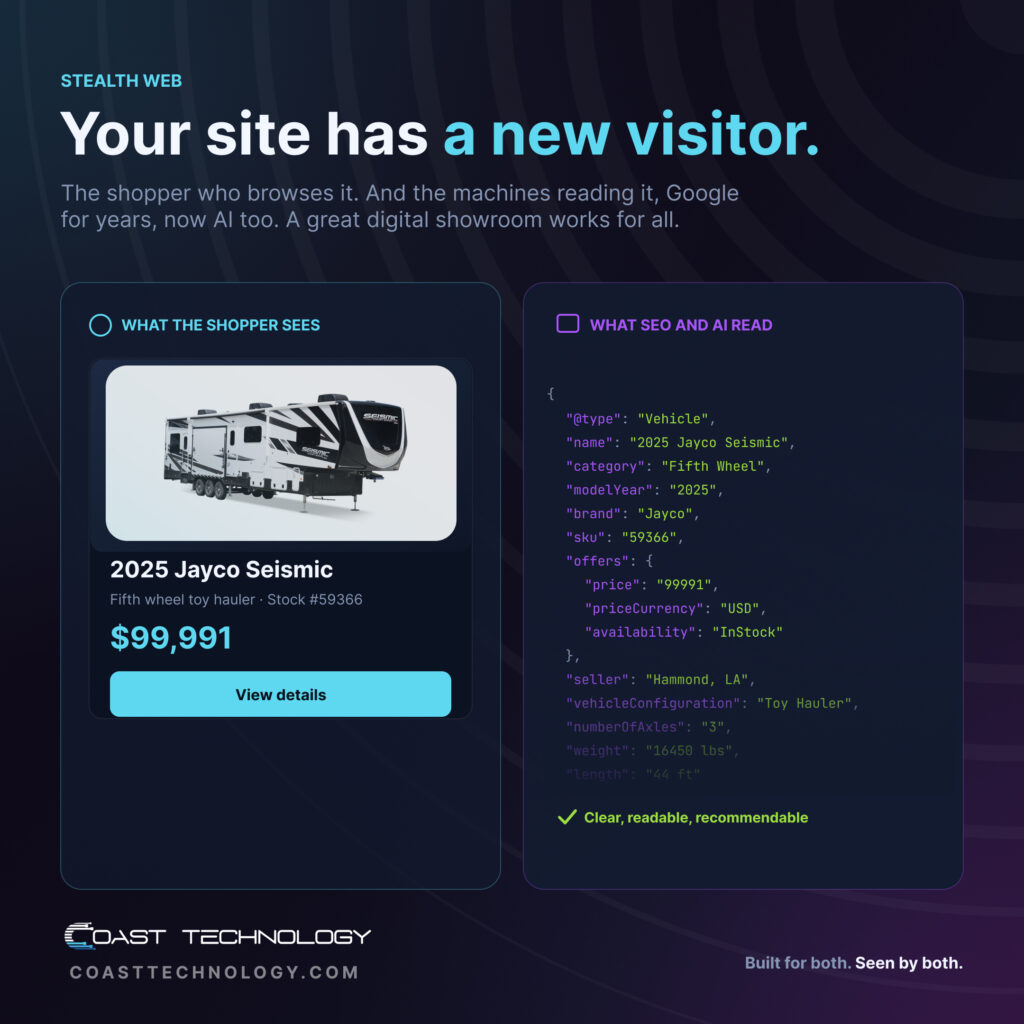
Your website has a new reader. And it isn't a person.
June 23, 2026
SEO, AIO, AEO, and GEO: How STEALTH's LLMs.txt Integration Future-Proofs RV, Marine, and Powersports Dealer Websites
October 1, 2025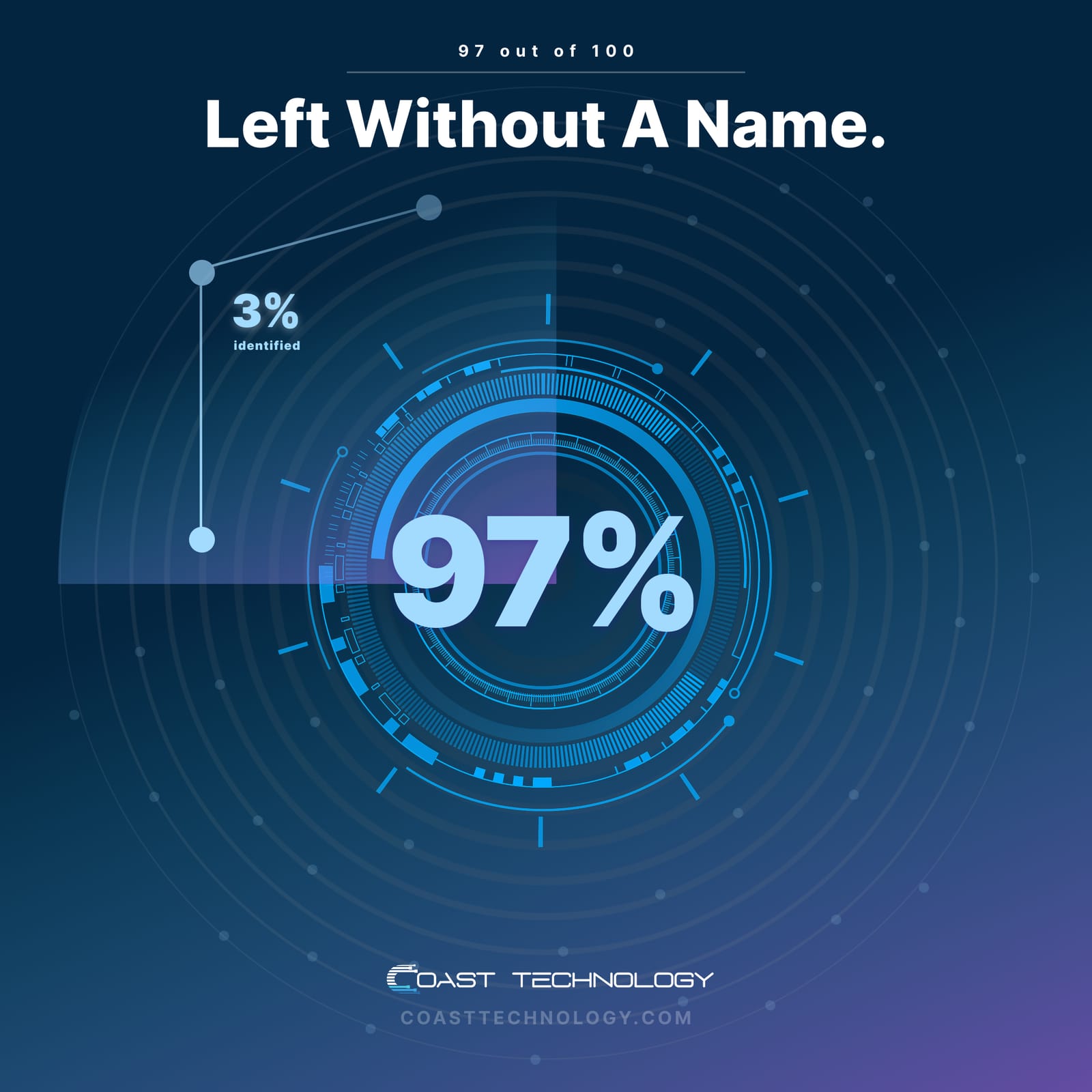
Anonymous traffic isn't real traffic. STEALTH sees the real traffic.
June 3, 2026Ready to Unmask Your Dealership's Traffic?
Stop Guessing. Start Knowing. See exactly who is on your website and convert anonymous shoppers into showroom buyers today.