What Happens Before the Walk-In, the Form Fill, and the Facebook Click
CTV advertising doesn’t get a last click. It doesn’t get a form fill. By the time your CRM sees the lead, CTV’s job is already done.
Here’s a scenario that plays out at dealerships every single month:
A customer walks into your showroom on a Saturday. The sales manager asks how they heard about you. “Oh, I don’t know — I was just in the area.” The CRM logs it as a walk-in. Advertising gets zero credit.
But what if that customer had been served your ads 640 times across 61 streaming channels in the 31 days before they walked in?
That’s not hypothetical. That’s a real lead from a real campaign — and without CTV intelligence, the influence is completely invisible.
The Attribution Gap Every Dealer Has
Last-click attribution is the default model for most CRM platforms. Whatever interaction happened right before the lead came in, that’s what gets the credit. A contact form submission credits “website.” A text message credits your texting platform. A walk-in credits “showroom.”
It’s not wrong, exactly. It’s just incomplete.
What your CRM can’t see is the weeks of streaming TV, audio, and OTT exposure that conditioned that prospect before they ever took action. And when you can’t see it, you can’t defend it — which means CTV advertising looks like it’s doing nothing, even when it’s doing everything.
Here’s what a real month of campaign intelligence revealed for one of our dealer clients:
| CRM Lead Source | What Actually Happened |
|---|---|
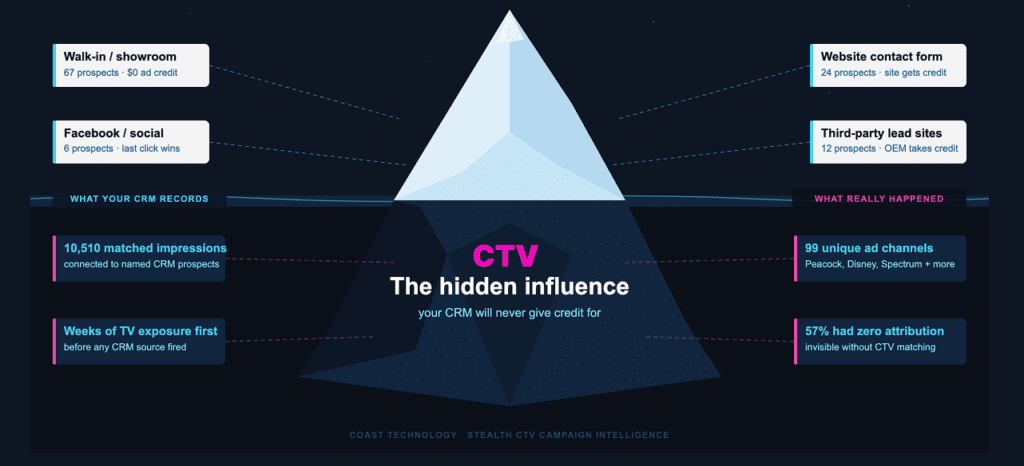
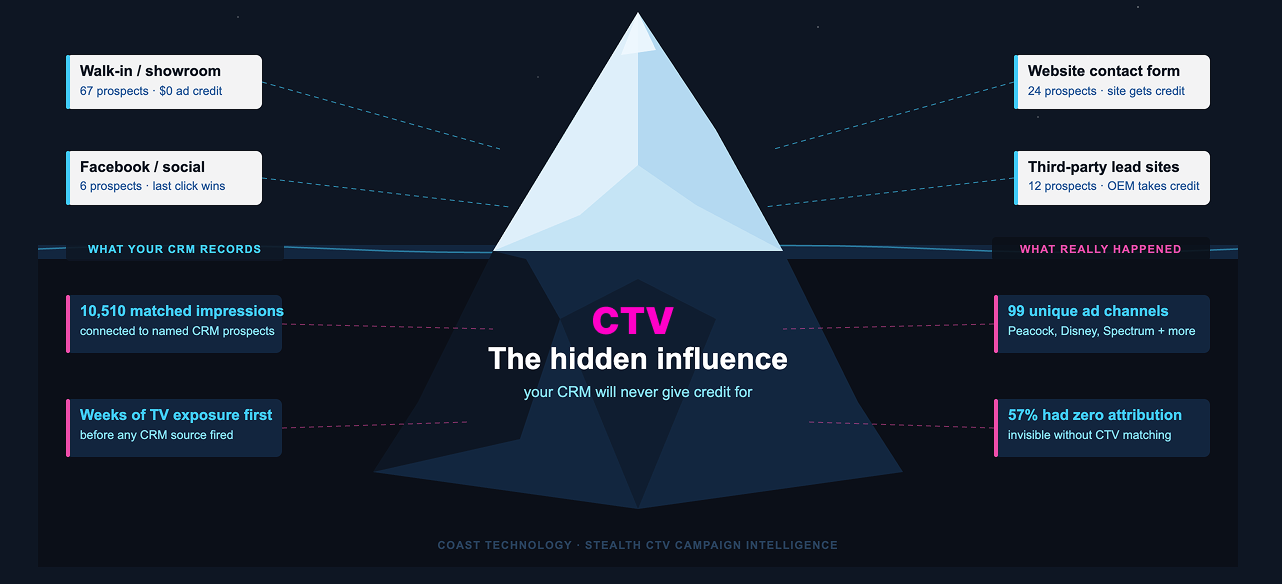
| Walk-In (67 prospects) | Seen ads 168–640× before entering the store |
| Website Contact Form (24 prospects) | Seen ads 58–692× before filling the form |
| Facebook / Social (6 prospects) | CTV campaigns ran 4 weeks before the Facebook click |
| Third-Party Lead Sites (12 prospects) | Dealer’s CTV was running the entire time |
| Phone / Text (3 prospects) | 641 impressions served before the first text |
| Referral / Other (5 prospects) | CTV built the brand awareness that warmed them up |
57% of the reached prospects had zero digital attribution in the CRM — yet every single one had been actively served CTV impressions.
Six Real Leads. Six Attribution Failures.
1. “He Just Walked In.”
A prospect shows up at the dealership. CRM: Walk-In. Ad spend credit: $0.
The reality: 640 CTV and audio impressions across 61 channels throughout the month — Spectrum Streaming, Peacock, Disney/Hulu/ABC/ESPN, Vizio OTT, Boat Trader, and 56 others. Three active campaigns. Thirty-one days of continuous exposure.
The truth: That wasn’t a walk-in. That was a conversion — one your CRM never connected to your advertising.
2. “The Text Message Lead”
A prospect texts through the dealership’s texting platform. CRM: “Text Platform Lead”. Ad spend credit: $0.
The reality: 2,641 matched ad impressions on 61 channels, the same month, the same saturation campaign as the showroom walk-in.
The truth: Texting platform captures the conversation. It doesn’t create the desire. CTV did that first.
3. “Facebook Sent Us a Lead”
A prospect clicks a Facebook ad and submits a form. CRM: Facebook lead. Facebook gets the budget justification.
The reality: 701 CTV and audio impressions across 57 channels before Facebook ever got its conversion event. Spectrum, Peacock, Vizio, LG TV FAST Channels — all running upstream.
The truth: Facebook is great at the last click. CTV is great at building the intent that makes someone click. One without the other is half the story.
4. “They Filled Out Our Contact Form”
A prospect submits a Contact Us form on the website. Website platform gets attribution credit.
The reality: 692 matched impressions across 57 channels — all before this prospect ever visited the contact page.
The truth: Filling out a form isn’t the start of the buyer journey. It’s the end of an awareness journey that CTV already built.
5. “Another Walk-In We Can’t Explain”
Another showroom visitor with no traceable digital path. CRM: Walk-In.
The reality: 168 impressions across 37 unique channels — Spectrum, Disney/Hulu/ABC/ESPN, Peacock, Vizio, and targeted podcast networks.
The truth: Walk-ins are the hardest leads to defend in any attribution conversation. But this data shows it wasn’t accidental foot traffic. That was earned awareness through weeks of streaming exposure.
6. “The OEM Stole Our Credit”
A prospect submits a quote request on the manufacturer’s website. OEM platform gets the form fill. Dealer gets nothing.
The reality: 350 matched CTV impressions across 58 channels — the dealer’s campaigns were running the entire time.
The truth: Third-party and OEM lead sources are structurally designed to take credit for buyer intent your advertising already built. This is one of the most common — and most expensive attribution failures in dealership marketing.
What the Data Actually Showed
When prospect lists were matched against CTV impression logs for the month, the campaign intelligence revealed:
-
- 117 named prospects reached by CTV advertising
-
- 10,510 total matched impressions connected to real people already in the CRM
-
- 99 unique ad channels used to reach those prospects
-
- 14 active campaigns running simultaneously
The CRM credited walk-ins, Facebook, third-party sites, and a texting platform. CTV intelligence revealed those same leads had been conditioned by streaming TV campaigns running for weeks before any of those “sources” ever came into the picture.
And it’s worth remembering what CTV actually is…it’s television! Not a banner ad, not a social post. A 30-second branded spot on Peacock, Disney, or Spectrum Streaming, served to a named prospect on their living room screen. The difference from traditional TV is that it’s targeted, measurable, and matched back to real people in your CRM. Dealers have trusted TV to build brand awareness for decades. CTV does the same job with the accountability traditional broadcast never could.
But none of that influence shows up in the CRM — and that’s where the real problem starts. Budget decisions get made from CRM data. When walk-ins show no ad attribution, the instinct is to cut awareness spend and double down on what the CRM can see: more third-party leads, more Facebook, more bottom-funnel spend. But if CTV was the reason those walk-ins happened in the first place, cutting it doesn’t save money. It removes the upstream influence that was making everything else work.
Full attribution doesn’t just tell a better story. It protects the spend that’s actually driving results.
How to Stop Losing the Attribution Argument
The problem isn’t that CTV doesn’t work. The problem is that standard CRM attribution can’t see it working.
Prospect-level CTV matching changes that. By matching your named lead list against impression auction logs, you can see exactly which prospects were exposed to your ads — on which channels, how many times, and across which campaigns — before they ever converted.
This doesn’t replace your other reporting. It completes it.
When a walk-in happens, you can show what drove it. When Facebook takes credit for a conversion, you can show what ran upstream. When an OEM form steals your attribution, you have the data to tell the real story.
What Gets Measured Gets Kept
CTV advertising is often the first thing on the chopping block when dealers are evaluating ad spend — precisely because it’s the hardest to attribute with traditional tools. That’s a measurement problem masquerading as a performance problem.
The dealerships that retain their CTV investment aren’t just running better campaigns. They’re running better attribution. They know what their streaming ads did before the lead ever showed up, and they can prove it.
Your CRM sees the last thing that happened. CTV intelligence shows you everything that happened first.
Ask us how we run this match against your customer list. Let’s start a conversation or Request a demo.